
Bid Preparation & Budget Planning
Prepare a bid with fewer hidden assumptions.
Compare scope requirements with drawings and specifications before assembling the budget. Track exclusions, alternates and missing subcontractor inputs so commercial decisions have a clear basis.
A bid needs a clear relationship between tender requirements, drawing scope and the information supplied by trade contractors. Missing inclusions or inconsistent assumptions can make apparently similar quotations difficult to compare.
The contractor remains responsible for bid approval, contractual commitments and final submission.
Discuss Your Project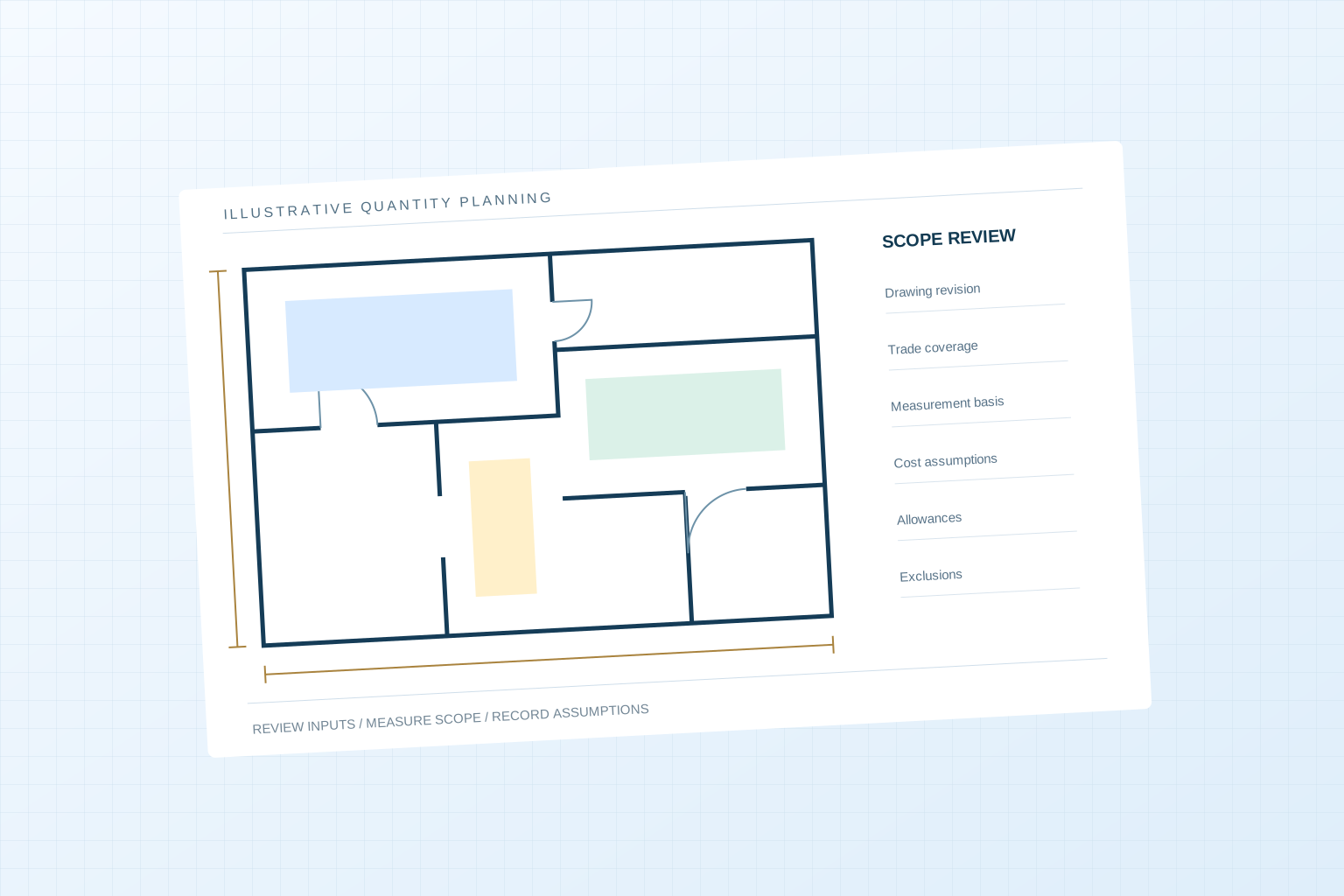
Check the scope before assembling the bid.
A scope matrix can identify which trade covers an item and where a clarification is still required. Alternates, allowances and owner-supplied work should be visible rather than blended into the base comparison.
The scope can bring together bid scope matrix, trade package comparison, alternate pricing schedule, budget risk register. Each output is agreed against the source information, intended use and review responsibilities before production begins.
Bid Preparation & Budget Planning Scope
- Bid scope matrix
- Trade package comparison
- Alternate pricing schedule
- Budget risk register
- Trade scope and exclusion matrices
- Alternate and clarification schedules
Project Contexts
- Tender scope reviews
- Subcontractor comparison schedules
- Budget and alternate planning
Organize exclusions and alternates before the deadline.
The contractor remains responsible for approving the bid, accepting contractual terms and making the final submission. Support should focus on the agreed estimating, comparison and organization tasks without implying authority to commit another party.
A useful starting package includes tender documents, bid instructions, submission deadline and available trade quotations. The review establishes which records can be relied upon, which need clarification and how the deliverables will be checked before issue.
- Trade scope and exclusion matrices
- Alternate and clarification schedules
- Project-specific deliverables and review milestones

What your project scope can include.
- 01
Review the Tender
Identify submission requirements, source revisions and key dates.
- 02
Map the Trades
Organize coverage, exclusions and unresolved scope interfaces.
- 03
Compare the Inputs
Review quotations, quantities and alternates on a consistent basis.
- 04
Prepare the Decision Record
Deliver the agreed budget or bid-support package for approval.
Questions before we begin.
Can you compare subcontractor quotations?
A comparison can be scoped if the quotations and required work are available. Differences in inclusions, qualifications and source revisions should be identified before comparing totals.
Will you submit a bid on our behalf?
Final authorization and submission remain with the contractor unless a separate, explicit administrative arrangement is agreed. The standard scope is bid preparation support.
How should alternates be presented?
Keep the base scope and each alternate distinct, with its assumptions and effect clearly stated. That makes later commercial decisions easier to review.
What should I send for a project-specific proposal?
Tender documents, bid instructions, submission deadline and available trade quotations. The contractor remains responsible for bid approval, contractual commitments and final submission. Scope, review rounds and delivery dates are confirmed after the source information is assessed.
Explore design directions.

Residential context
Illustrative architectural and documentation coordination.
Building coordination
Connecting project requirements and technical inputs.
Illustrative concepts — not completed client projects.
Let’s define your bid preparation & budget planning scope.
Share your location, available documents and project goals.